
The Emperor
and last call for "Concentration Without Effort:" A Six-Week Course on the Major Arcana

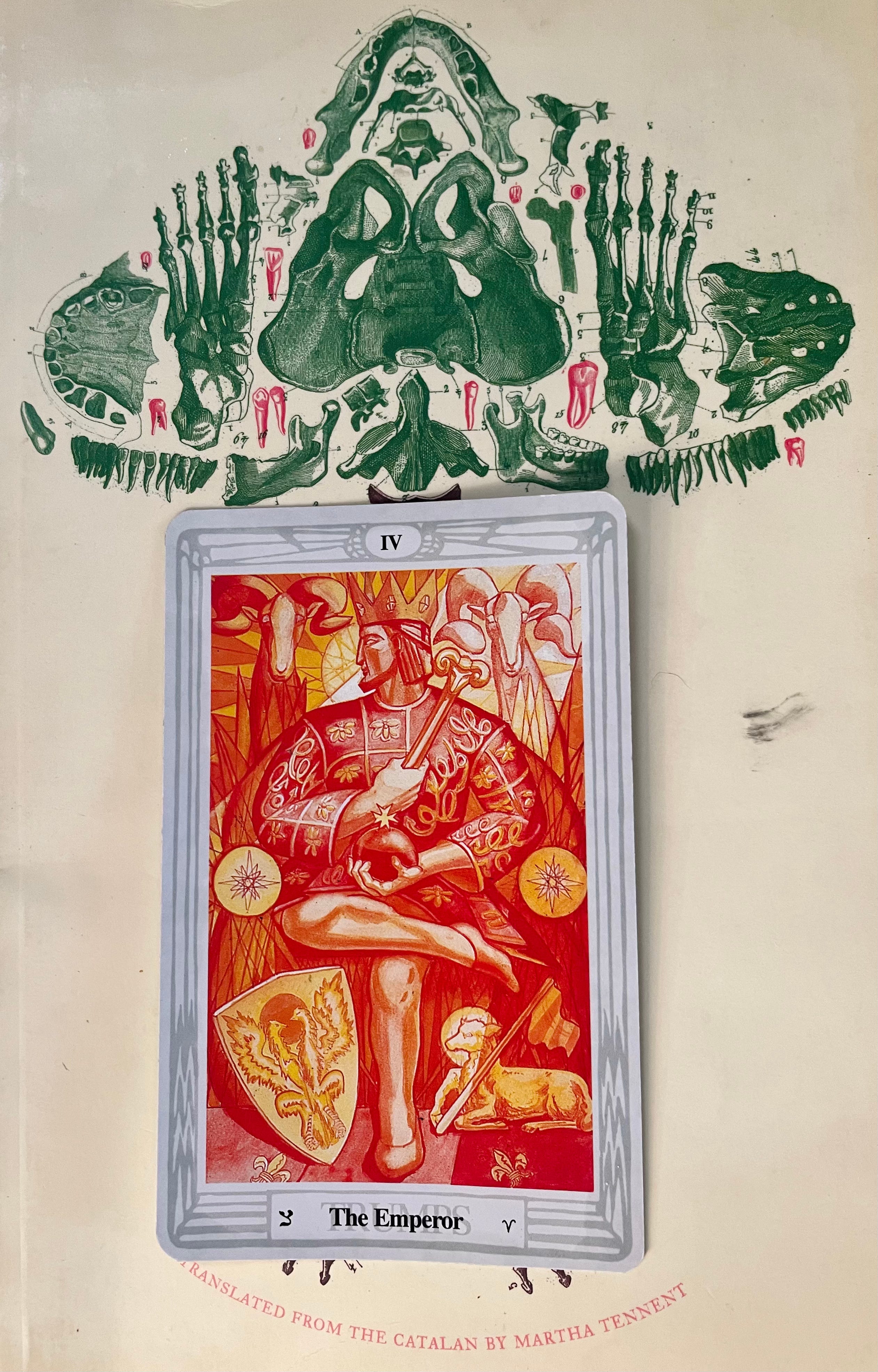
You’ll find new additions to the interruptions tarot book below, including an interpretation of The Emperor inspired by Mercè Rodoreda's strange, lovely, and devastating novel Death in Spring. You can read more about the tarot book project here, and the definitions for the other cards I’ve drawn so far here.
Happy Imbolc and Happy Full Moon in Leo! I’m excited to be teaching this Wednesday night the first workshop in “Concentration Without Effort,” my six-week series on the Major Arcana of the tarot. We have just four spots left in the class, if you’d like to join us before we begin! You can learn more about how we’ll approach the majors as creative, spiritual, and psychological guides into the magic of the everyday here.
New Additions to the Majors
The Emperor (4)
Narrated by a young boy who struggles to reconcile the beauty of his waterside village with the ritualistic violence of the adults in the town, Mercè Rodoreda’s Death in Spring is, strangely enough, a book about the struggle of The Emperor. How do you respond when you are confronted at once with beauty and terror? What does it mean to live in a world that allows for the highest to exist alongside—within, even—the lowest, and vice versa? Rodoreda’s narrator lives these questions through a poetic, unflinching ability to see all of it, to wonder about all of it, even when he needs dark humor and the rough currents of the river that buttresses his village as comfort for, steel against, and encounter with death, brutality, and the seeming senselessness of it all. The boy admits that he prefers night to daytime, because even though he is afraid of the darkness, its low moonlight offers a balm, a kind of ease of navigation through “the utter hopeless ugliness of some things become too enormous” in the light of broad day. But neither boy nor Emperor shirks the implications of such ugliness; they understand the fact that ugliness, if it is apparent in the external world, must somewhere be contained within them too. Associated with the cardinal fire sign of Aries and guarding the path between Foundation and Victory on the Tree of Life, the Emperor rules experiences where the querent must learn how to see and travel by night and by day, sometimes at the same time. Upright, the Emperor confers righteousness—the Hebrew letter “tzaddi”—on its querent as one discovers how to acknowledge hopeless ugliness in moments of apparent beauty and beauty in moments of hopeless ugliness, without jumping to reactivity and rash judgment. Reversed, questions arise about the assumptions you’ve made about reality, as well as the conclusions you’ve drawn about what it means to be a “good human,” based on your preferences for day or night consciousness. Is virtue always tied to practical action? Is there really such a clear boundary between you and the people who seem to deserve your hate?
The Devil (15)
There’s a mountain pass covered in snow and you’ve got an injured puppy in your car and a sick child waiting for you at home. You’re tired from lack of sleep, a bad mood, and a preoccupation with how, despite your best intentions, evil seems to slip into your life, between the seams. You’ve got apologies to proffer, bills to pay, beings to nurse back to health. You take the mountain pass even though you’re worried about the road. It’s the quickest way home. It’s the most beautiful way home. As you drive, you find your heart lifting with the sunlight’s reflection on the snow, or shuddering when the four-wheel drive whines over a patch of black ice. In your heart of hearts, you know you’ll make it home. In your heart of hearts, you know that love will carry you through illness and apology, fear and banality. In your mind, though, you notice the shadows amongst the rocks, and look: there’s the quiet thought that the car might skid off the cliff, your dog might die, your daughter might die, you might die, and none of it will be worth it, will it? Not the sorrows or exhaustions or strivings or even giving up … all of the sudden quiet thought has become a muddle of intensity, and the car shakes as if to prove that your quickest route to your heart’s desire is just as deluded and stupid as everything else in your deluded, stupid life. You’re going to die! You’re in the felt sense of the demonic for what seems like an eternity. But then you don’t die. You make it home! And the sun sets with your arms thrown around your snotty baby and your snoozing dog. There’s a giggly feeling shot through everything as night falls in January, a giddiness at having broken free of some bad contract. Welcome to the Devil card, which treads the path between the paranoid, obsessive Glory of the Mind and the Beauty of Reality even in the face of its horror, its icy nooks and crannies. Associated with the cardinal earth sign of Capricorn, the Devil turns up when the shadows grow long and threaten to coagulate into monsters you wish you didn’t believe in. The power of the card is the anti-fragility it bestows upon you, even in those long, drawn-out moments of terror and worthlessness. The beauty of the card is the ability to laugh—to be mirthful—as you face down the demons of your own creation. Upright, you’re learning how to reject the notion that fear and negative feeling means life doesn’t contain glory and beauty, love as such. Reversed, how can you keep your eyes open even though you’re afraid of what’s gotten into you through the cracks in the Real? How can you remind yourself that the quickest “way home” can be travelled at a slow and steady pace, with as many check-ins with yourself and loved ones as you need?
New Additions to the Minors
Six of Swords
This card is the victory of the intellect in transforming communication into expression, without sacrificing either precision or beauty in the process.In Reclaiming Art in the Age of Artifice, JF Martel distinguishes between communication as an aesthetic mode with an an agenda and expression as an artistic mode that is useless in the highest sense—art for art’s sake, art that conjures the human rather than the other way around. Oftentimes, communication and artifice attempt to masquerade as art, but never really achieve the latter’s numinosity. On the other hand, art, as part of its ineffability, does sometimes include the communication of argument, information, law. Associated with the god of language, Hermes, in the fixed air sign of Aquarius, the Six of Swords offers the querent a rare experience of art as both ineffable and communicative, at once mysterious and scientific. This is Beauty in Formation, and the card turns up when language—as Logos, as magic, as art—is conjuring you, communicating through you, too. Upright, the card offers the ability to “seek interiorly for a higher source” of wisdom, in the words of 18th-century mystic Karl Eckartshausen. Reversed, are you scrolling your phone or seeking artifice as a proxy for art?
Four of Disks
This card calls forth the paradox of true power: it is only attained, never mind held onto, when one is seeking its opposite, which is love, surrender, or, in the words of this card’s place on the Tree of Life, mercy in action. Associated with the Sun ruling the last ten degrees of the cardinal earth sign of Capricorn, commentators throughout the history of the tarot have often focused on the grippy, miserly, tyrannical expression of this celestial correspondence. King Midas and his tragic thirst for gold appears often in mention of this card. That thirst is a punishment—a trick played on him by the gods—for his fundamental misunderstanding about the nature of freedom (it comes from the inside) and the nature of authority (it comes not from power over or power deferred, but from a true contact with that golden, radically free place inside oneself). When this card turns it up, it offers the querent a chance to recognize the desire for power as well as the desire behind the desire, which is to participate in and offer mercy, to oneself and many others besides. Upside down, scarcity and fear of failure run the risk of turning you into a Midas-like figure or, worse yet, playing the role of a god who can bestow curses and turn other people into Midases as punishment. What kind of being are you if such a “justice” is the perceived point of infinite power?